

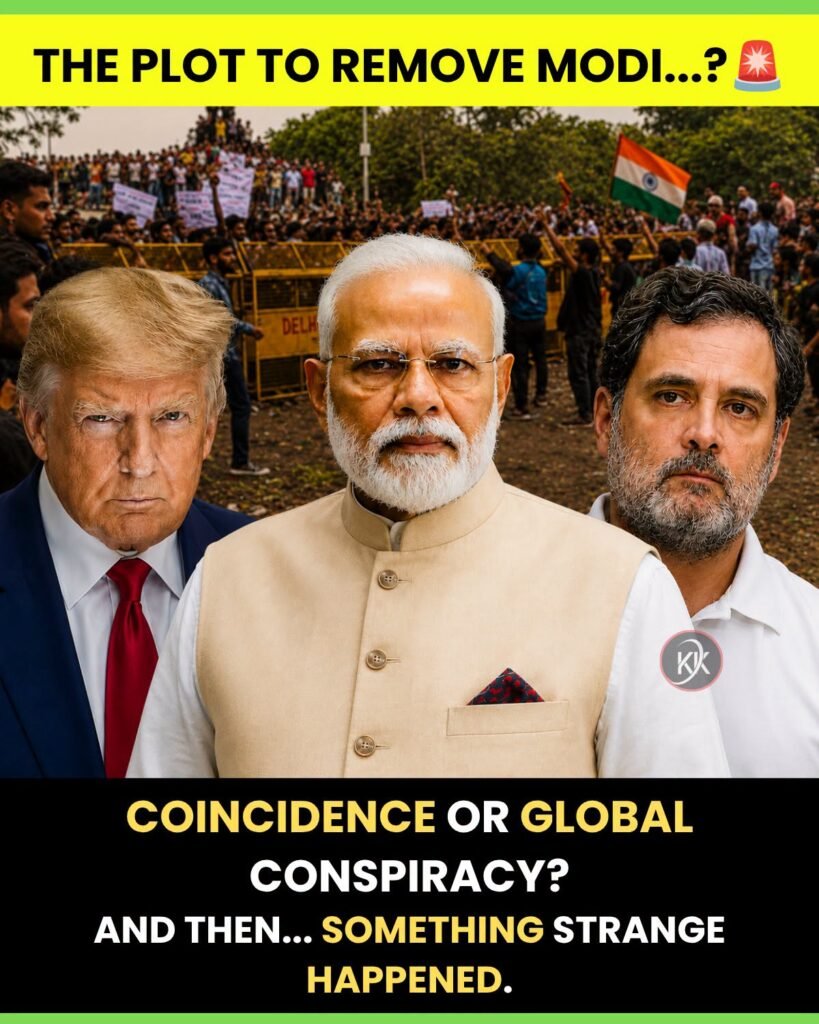
The Plot to Remove Modi… Coincidence or a Broader Geopolitical Strategy?**
Following the Indian Air Force’s **Operation Sindoor**, speculation began circulating about a hidden Pakistani nuclear facility. Some commentators suggested the site might have had undisclosed strategic significance involving the United States. **However, no publicly available evidence has confirmed these claims.**
Soon afterward, another development drew widespread attention.
Within hours of the operation, **U.S. President Donald Trump** repeatedly claimed that he had **brokered a ceasefire** between India and Pakistan. The Modi government firmly rejected the assertion, stating that **no U.S.-mediated ceasefire had taken place**. Despite India’s position, Trump continued to repeat the claim on multiple occasions.
In the days that followed, Trump spoke about pursuing a **limited trade agreement** with India. India did not move forward with the proposal, and observers noted that bilateral tensions appeared to increase.
Around the same period, a prominent Indian opposition leader made several overseas visits, some of whose destinations were not publicly disclosed. These trips generated considerable discussion on social media, **although no evidence has linked those visits to subsequent political developments in India.**
The debate intensified further when the United States announced a **50% tariff on certain Indian goods**, citing India’s continued purchases of Russian oil. Critics questioned why **China**, another major importer of Russian energy, was not subjected to the same measure. When asked about China, **JD Vance** described the situation as “complicated,” a response that further fueled public discussion.
Some analysts argue that Washington had already grown frustrated with New Delhi over several independent strategic decisions, including the **Surgical Strikes**, the **Balakot airstrike**, the **abrogation of Article 370**, and India’s decision to maintain relations with Russia and Iran despite Western pressure. Others disagree, arguing that these differences reflect normal diplomatic disagreements rather than evidence of a coordinated geopolitical campaign.
Supporters of this theory also point to political developments in neighboring countries. They cite **Imran Khan’s** allegations of foreign interference following his removal from office in Pakistan in 2022 and claims made by some commentators regarding external geopolitical interests during Bangladesh’s 2024 political crisis involving **Sheikh Hasina**. **These comparisons remain disputed and have not been conclusively established.**
According to supporters of the theory, earlier political movements—including the **CAA protests** and the **farmers’ protests**—did not achieve their intended political impact. They argue that attention later shifted to the controversy surrounding India’s electoral rolls. Government supporters contend that the focus was intended not only to identify inaccuracies but also to create public doubt about election outcomes. Critics reject that view, maintaining that voter-roll concerns deserve transparent, independent examination.
The discussion quickly spread across **social media, television debates, and online platforms**, amplifying competing narratives. Supporters of the government argue that repeated but unverified allegations can weaken public trust in democratic institutions, deepen political polarization, and attract unnecessary international attention. Critics counter that raising questions about electoral processes is a legitimate part of democratic accountability when supported by credible evidence.
For those advancing this theory, the timing of events—including trade tensions and the electoral-roll controversy—appears significant. Others see no coordinated pattern, arguing that these developments can be explained by domestic politics, international diplomacy, and evolving geopolitical interests.
Whether these events represent isolated developments or part of a broader geopolitical strategy remains open to interpretation. **The available public evidence does not conclusively establish a coordinated effort**, leaving readers to examine the facts, consider competing viewpoints, and draw their own conclusions.
#India#OperationSindoor#NarendraModi#Geopolitics#IndiaUSRelations#NationalSecurity#CurrentAffairs#Politics#WorldNews#Democracy
